
2026 IEEE 5th International Conference on Electronic Information Technology (IEEE-EIT 2026)
| Prof. Lijia PanNanjing University, China IEEE Senior Member; selected as a New Century Excellent Talent by the Ministry of Education in 2010; funded by the National Science Fund for Distinguished Young Scholars in 2018; as the second key contributor, awarded the Second Prize of the National Natural Science Award in 2017 and the First Prize of Jiangsu Provincial Science and Technology Award in 2016. Currently a Professor and doctoral supervisor at the School of Electronic Science and Engineering/National Center for Micro-Structure Collaborative Innovation, Nanjing University. His research focuses on polymer electronic materials and devices, electronic skin devices, and bionic sensing devices. He has published over 200 papers, with more than 18,000 SCI citations and an H-index of 55. Invited to contribute eight chapters in Chinese and English monographs published by Science Press, Wiley, Elsevier, World Scientific Publishing, and other publishers. |

| Prof. Pingzhi FanSouthwest Jiaotong University, China Pingzhi Fan is currently a distinguished professor at Southwest Jiaotong University (SWJTU), director of the Institute of Mobile Communications, and honorary dean of the Sino-UK SWJTU-Leeds Joint School. He also holds visiting/guest professorships at the University of Leeds (UK, 1997–present) and Shanghai Jiao Tong University (China, 1999–present), and an honorary professorship at the University of Nottingham Ningbo China (UNNC, January 2025–present). He served as Vice President for Academic Affairs at SWJTU from 2007 to 2014, Dean of the Graduate School (SWJTU) from 2007 to 2012, and Dean of the School of Information Science and Technology (SWJTU) from 1998 to 2008. He is a recipient of the UK ORS Award, the NSFC Outstanding Young Scientist Award, IEEE VT Society Jack Neubauer Memorial Award, IEEE SP Society SPL Best Paper Award , IEEE VT Society Best Magazine Paper Award, and several IEEE conference best paper awards. He served as chief scientist for a national 973 research project, IEEE VTS Distinguished Lecturer, and Distinguished Speaker. He holds fellowships from IEEE, IET, CIE, and CIC. He also serves as guest editor-in-chief, guest editor, or editorial board member for several international journals. He is the founding chair of the IEEE VTS Beijing Chapter and IEEE |
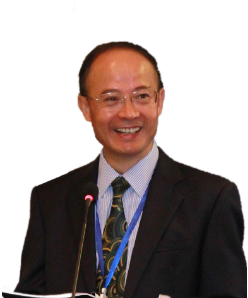
| Prof. Pingyi FanTsinghua University, China (IET Fellow) Title: Generative Semantics for 6G: Distortion-Resilient Transmission and Training-Free Adaptation Tenured Professor in the Department of Electronic Engineering at Tsinghua University, Director of the Open Data Cognitive Innovation Center, Academician of the United States National Academy of Artificial Intelligence (US-NAAI), Co-Chair of the Academic Committee of the NAAI Asia Research Institute, Fellow of the Institution of Engineering and Technology (IET Fellow), and member of the IET Fellow International Review Committee. He has published over 600 academic papers, filed more than 40 national patents and 7 international patents, and authored 5 academic monographs. He serves as Deputy Director of the Information Theory Subcommittee of the China Institute of Electronics, Co-Chair of China 6G-ANA TG4, and Chair of the IEEE ChinaSIP Network and Communication Technology Committee, among other positions. His recent main research areas include 6G wireless communication networks and machine learning, semantic information theory and generalized information theory, big data processing theory, as well as intelligent network and system detection. |

| Prof. Guangyi LiuChina Mobile Communication Co., Ltd., China Title: 6G key technology and Industrialization Dr. Guangyi Liu, 6G Director of China Mobile Communication Corporation (CMCC), founding member and co-chair of the 6G Alliance of Network AI (6GANA), Board member of NGMN (Global mobile operator alliance), Vice chair of THz industry alliance in China, vice chair of the wireless technology working group of IMT-2030 (6G) promotion group supported by Ministry of Information and Industry Technology of China. He is leading the 6G R&D in CMCC since 2018. He has led the R&D of 4G’s evolution and 5G in CMCC during 2006~2020. He has acted as spectrum working group chair and project coordinator of LTE evolution and 5G eMBB in Global TD-LTE Initiative (GTI) from 2013~2020 and led the industrialization and globalization of TD-LTE evolution and 5G eMBB. |

| Prof. Lin ZhangUniversity of Electronic Science and Technology of China, China Title: Interference-Aware GNN for Energy-Efficient Resource Allocation in Dynamic Space-Air-Ground Integrated Networks Lin Zhang (M’17) received the Bachelor degree in communication engineering from Sichuan University, Chengdu, China, in 2011, and received the Ph.D. degree with the National Key Laboratory of Science and Technology on Communications, in the University of Electronic Science and Technology of China (UESTC), Chengdu, China, in 2017. He is currently a professor in the UESTC. From Oct. 2014 to Apr. 2016, he worked as a Visiting Student with the school of electrical engineering, Royal Institute of Technology (KTH), Sweden. His research interests include cognitive radio, D2D communication, content caching, non-orthogonal multiple access, short packet communications, and intelligent wireless communications. He won the IEEE GLOBECOM 2012 Best Paper Award and Student Travel Grant Award, and IEEE ICC 2019 Best Paper Award. He also received IEEE Region 10 Distinguished Student Paper Award in 2016. |

| Assoc. Prof. Gang LiuSouthwest Jiaotong University, China Title: Vehicle Communications and Positioning Technology for Smart Transplantation: from Car to Train Gang Liu is currently an associate professor and Ph.D supervisor at the School of Information Science and Technology, Southwest Jiaotong University (SWJTU), Chengdu, China. He received the Ph.D. degree in Communication and Information Systems from Beijing University of Posts and Telecommunications (BUPT) in 2015, and the B.S. degree in Electronics and Information Engineering from Sichuan University (SCU) in 2010. He was also with the University of British Columbia and Carleton University as a visiting PhD student from Nov. 2013 to Nov. 2014. His current research interest lies in the next generation cellular networks, integrated communications and sensing, connected vehicle networks and wireless communications for railway. He has co-authored more than 70 technical papers in international journals and conference proceedings, with 2 highly cited papers and more than 2000 citations in total. |
